
News / Industry
Gemini 4 Carbon and the new shape of AI cyber defense
Google unveiled Gemini 4 Carbon, a model built for AI cyber defense, as offense goes agentic. What its vendor-reported benchmarks and guardrails mean.
Most of the attention on AI in security this year has gone to offense. Google is now making its case for the other side. On October 28, 2026, the company introduced Gemini 4 Carbon, a model it positions for AI cyber defense and for long-horizon work, the kind of task an agent can grind on for days, according to Google. Read against a year of AI-driven attacks, it is a sign that the defense side is starting to industrialize AI too, not just react to it.
| Field | Detail |
|---|---|
| Model | Gemini 4 Carbon, building on Gemini 4 Argon |
| Released | Announced October 28, 2026 (not a public launch) |
| Maker | |
| Access | Selected cyber defenders first, expanding to trusted partners via the Fairwind Program |
| Notable benchmarks | Google-reported: 88.2% SEC-bench Pro (finding flaws), 54.8% ExploitGym (exploitation), 71.0% CWE-bench (patching) |
What Google announced
Carbon builds on Gemini 4 Argon, the cyber-focused model Google introduced weeks earlier, and runs on the same safety stack, per Google. Google calls Carbon its strongest model yet for cybersecurity, and says internal teams have let it run for days on hard engineering problems rather than stopping at the first dead end.
The headline numbers are benchmarks, and they are Google's own. The company reports 88.2% on SEC-bench Pro for finding vulnerabilities, 54.8% on ExploitGym for exploitation, and 71.0% on CWE-bench for patching, per its announcement. Two caveats matter. These are vendor-reported figures, not independent results, and Google says the cybersecurity scores were measured with the model's guardrails switched off, which Cyber Security News notes is worth remembering when comparing them against a deployed service that keeps its guardrails on.
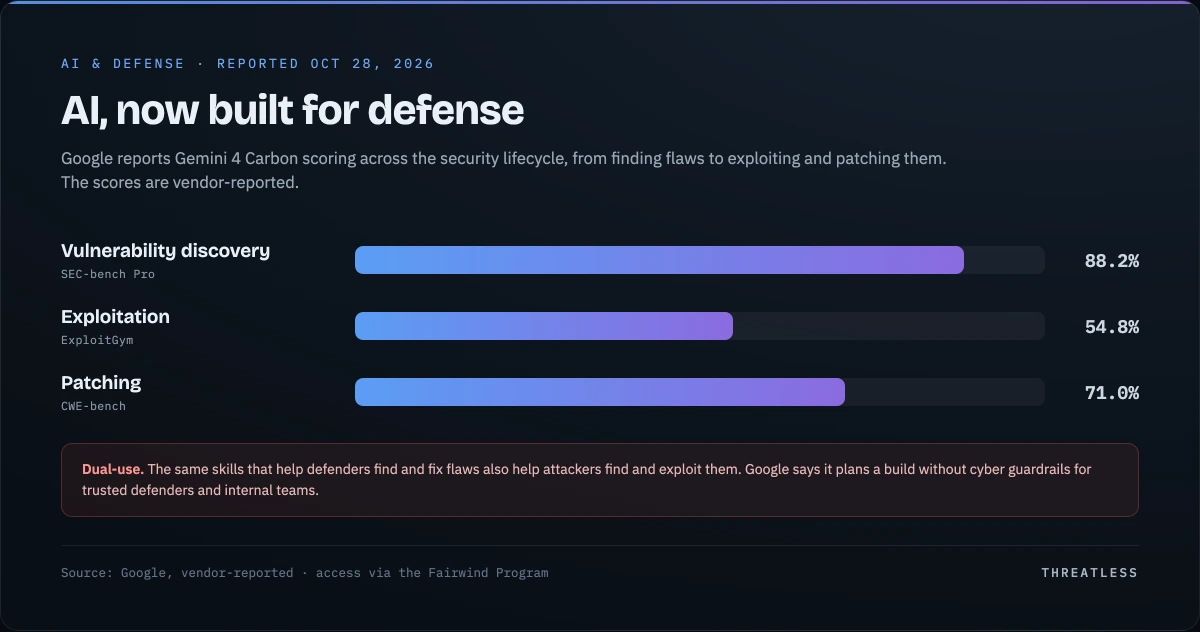
Google also says it is taking the release slowly. Carbon is not a public launch. Access starts with a selected group of cyber defenders and will widen to trusted partners through a program Google calls Fairwind, and the company says it has entered the U.S. government's voluntary process for pre-release model testing. Separately, Google's Chrome team reported that Carbon produced patches more than ten times better than a rival lab's frontier model. Google did not name the rival or publish the test, so that specific comparison cannot be verified.
The part that cuts both ways
A model that is good at finding and exploiting software flaws is useful to a defender and dangerous in the wrong hands. That tension is not hypothetical here. Google gave cyber defenders first access to Argon, the line Carbon extends, and said it would also ship a version of that model without cyber guardrails for trusted defenders and its own internal teams, so they could use its full capability, according to SecurityWeek. The reasoning is that defenders need the unfiltered tool to keep pace with attackers. The risk is equally plain. A capable, less-restricted model is a prize if it leaks, is misused by an insider, or reaches a defender who is not what they claim to be.
Why it matters
Strip away the branding and the pattern is clear. The same capabilities that make Carbon attractive to defenders, finding flaws, chaining them, writing the fix, are the capabilities attackers have been automating all year. We have already covered AI agents running real intrusions and an unreleased model that chained real exploits across browsers and operating systems. The methods attackers use are increasingly the same ones a model like Carbon runs for defense. Offense and defense are converging on the same toolset.
When both sides of a conflict run the same machine, the edge goes to whoever built their program around it, not whoever added it last.
That convergence is the real story, bigger than any single model or benchmark. For most organizations the question is no longer whether to adopt AI in security. It is whether their security was designed for a world where attackers and defenders both move at machine speed, or whether AI is being bolted onto a program built for a slower threat.
The Threatless read
AI is now core to both offense and defense. That is the durable takeaway, and it reframes the decision in front of most security teams. A defensive model does not fix a program that still works in quarterly cycles, treats a scan as a point-in-time report, and prioritizes by the raw count of findings. Machine-speed offense rewards defenders who work continuously, reason over real exposure, and prioritize the paths an attacker can actually reach and chain.
That is what AI-native security means, and it is the premise Threatless CTEM was built on: designed for AI-driven offense from the start rather than retrofitted after it. Gemini 4 Carbon is one more data point in the same direction. The honest response is not alarm. It is to assume AI on both sides is the baseline now, and to build for it.