
News / Industry
Threat actors are now running real intrusions with AI agents
CrowdStrike says four threat actors ran AI agents inside real intrusions, and an agentic pentest tool is tied to 200-plus targets. What AI-driven offense means.
For years, "AI in offensive security" mostly meant a chatbot that helped write a phishing lure or explain a vulnerability. A human still ran the attack. New reporting from CrowdStrike marks a harder line: AI agents that make their own decisions and run commands inside live intrusions, not inside a research sandbox.
In a report published on October 21, 2026, CrowdStrike's Counter Adversary Operations team said four previously unreported threat actors used AI agents during real intrusions between roughly May and August 2026, across reconnaissance, exploitation and data theft. The company assessed, with moderate confidence, that these cases "likely demonstrate that agentic AI commoditizes baseline offensive cyber operations," per CrowdStrike.
| Field | Detail |
|---|---|
| Who | Four previously unreported threat actors, per CrowdStrike Counter Adversary Operations |
| What | AI agents making decisions and running commands inside real intrusions, from recon to data theft |
| When | Intrusions roughly May to August 2026; reported October 21, 2026 |
| So what | CrowdStrike assesses, with moderate confidence, that agentic AI is turning baseline offensive operations into a commodity |
What happened
CrowdStrike's cases varied in design. Some frameworks used multiple specialized agents working in parallel; others relied on a single agent following a detailed set of instructions. In several, operators used saved files and structured prompts to keep the agents working with little human input. All four, CrowdStrike said, found ways around model safeguards, often by presenting their activity as authorized security testing. The affected organizations spanned healthcare, government and software-as-a-service, among others.
A second thread runs in parallel. Researchers have tracked an agentic penetration-testing framework known as ARTEX being turned on real targets. The Hacker News reported that a China-linked group it tracks as Vapor Panda used the framework against more than 200 organizations, a count that is still provisional and differs across accounts. Microsoft, which tracks related ARTEX activity under its own naming, has tied the tool to intrusions across multiple sectors.
Why it matters
The significance is not a new class of exploit. It is a change in economics. The slow, skilled stages of an intrusion, the parts that long kept competent operations rare, are exactly what these agents automate. CrowdStrike notes that even lower-skilled actors are now using AI to compromise organizations, and that some operations ran with little supervision. Its hunting team reported roughly three times as many agentic intrusions in the second half of 2026, through the reporting period, as in the first half. That is what "commoditization" means in practice: more operators, running more intrusions, for less effort.
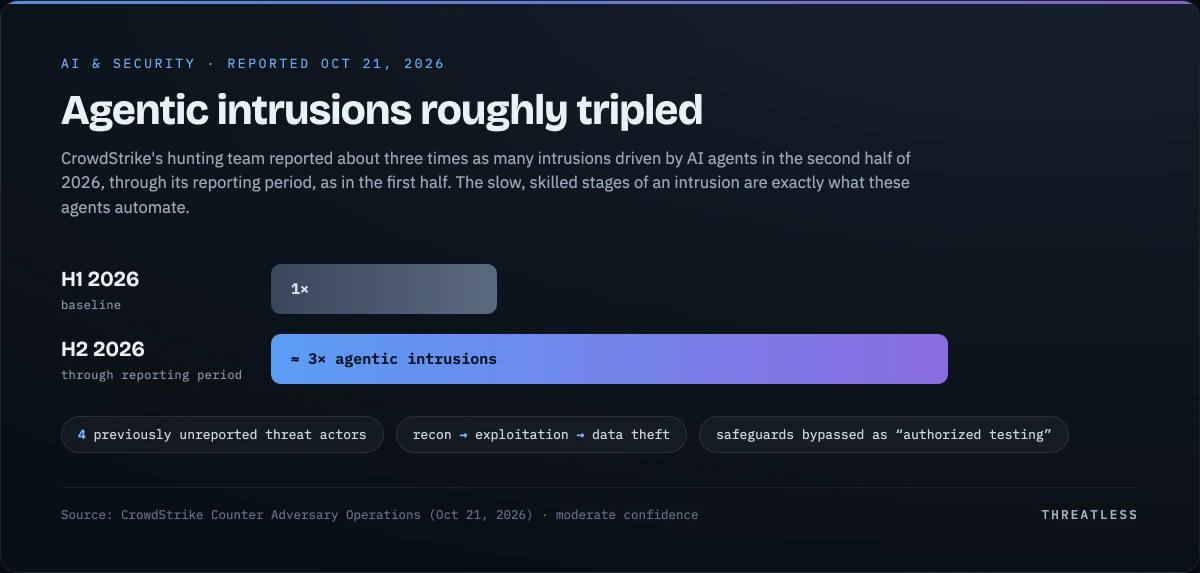
The costly, skilled stage of an intrusion is the part these agents automate, which changes who can run a competent attack, and how many they can run at once.
Defenders are not standing still. On October 19, 2026, Microsoft announced controls that treat AI agents as potential insiders rather than trusted software: permissions scoped to a single task and retired when it ends, continuous risk scoring, and human approval gates for high-impact actions, according to SecurityWeek. Microsoft's own red team has cautioned that attack chains can sometimes slip past those human-in-the-loop checks, a useful reminder that an approval gate is a control, not a guarantee.
This parallels what Anthropic reported in October, when an unreleased AI model chained real exploits across browsers and operating systems. One result shows AI finding and assembling exploits; the other shows AI operating inside real intrusions. Read together, they describe offense that is becoming AI-driven at both ends.
What it means for defenders
Strip away the agents and an older lesson gets sharper. When offense is automated, the unit of risk is the exposure an attacker can actually reach and chain into a path, not the raw count of findings in a report. Faster, cheaper operations reward defenders who work the same way: continuously, with evidence, and with hard prioritization of the exposures that carry real risk.
That is the case for treating exposure management as a standing discipline rather than a quarterly scan, and for building it to be AI-native, designed around AI-driven offense rather than retrofitted after it. It is the premise Threatless was built on. The actors in these reports are moving at machine speed. The honest response is not fear. It is a program that assumes this is the baseline now and is engineered for it.