
Blog / Security education
AI-native security: what it means and why it matters
AI-native security is defense built from the ground up for machine-speed attacks: continuous, evidence-driven, and prioritized by real risk, not AI bolted on.
AI-native security is security built from the ground up for a world where attackers and defenders both operate at machine speed. It describes a design and operating choice, not a product feature: a system that runs continuously, ranks what it finds by real risk, proves a finding is real before anyone acts on it, and scales with the volume that AI-driven offense now produces. The useful contrast is with AI-enabled security, which is a legacy tool with an AI feature attached on top. This guide defines AI-native security precisely, separates it from the related but different work of securing AI, and grounds the why-now in what changed across 2026.
What is AI-native security?
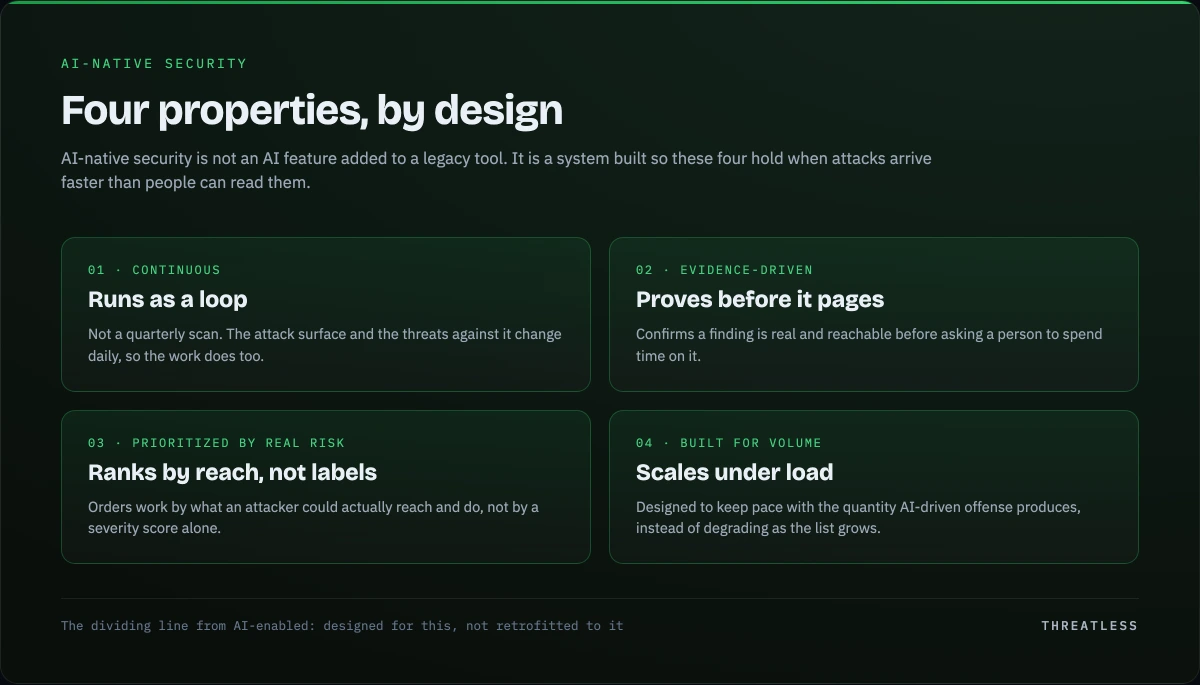
AI-native security is an approach in which the core assumptions of a security system, how it collects signal, how it decides what matters, and how fast it can act, are designed for an environment where both sides move at machine speed. Four properties define it.
Continuous. It runs as a loop rather than a periodic scan, because the attack surface and the threats against it change daily, not quarterly.
Evidence-driven. It confirms that a weakness is real and reachable before asking a person to spend time on it, instead of forwarding a raw severity score and leaving the triage to them.
Prioritized by real risk. It ranks findings by what an attacker could actually reach and do, not by a severity label alone.
Built for volume. It is designed to keep pace with the quantity of findings and attacks that AI-driven offense now generates, rather than degrading when the list grows.
None of these is a new idea on its own. What is new is treating them as the foundation of the system instead of as features added later. That is the whole distinction between AI-native and AI-enabled, and it is worth drawing out, because almost every security tool on the market now claims some form of AI.
AI-native vs AI-enabled: the bolt-on problem
Most tools that market AI today are AI-enabled, not AI-native. An AI-enabled tool is a product whose architecture predates the current threat model and which has had AI features attached: a chatbot that summarizes alerts, a model that scores a vulnerability, an assistant that drafts a report. The underlying engine still works the way it did before. The AI improves the surface and leaves the core untouched.
That is the bolt-on problem. A summary on top of a queue of thousands of findings is still a queue of thousands of findings. A model that writes a clearer description of a CVE does not change whether that CVE is reachable in your environment. So the useful question is not whether a tool contains AI. Almost all of them now do. The question is whether the system was designed, from its data model up, to operate continuously, prove its findings, and rank by real risk at the volume modern offense produces.
The table below sets the two apart across the dimensions that decide how a program behaves under load.
| Dimension | AI-enabled (bolt-on) | AI-native |
|---|---|---|
| Design origin | AI features added to a tool built for a slower era | Built from the ground up for machine-speed offense and defense |
| Handling volume | Degrades as findings grow: more alerts, same triage | Designed to scale with the volume AI-driven offense produces |
| Prioritization | Severity labels and static scores | Ranked by reachability, real-world exploitation, and business impact |
| Speed | Periodic scans and batch reports | Continuous loop that acts as the environment changes |
| Evidence | Forwards the scanner's verdict | Validates that a finding is real and reachable before anyone acts |
Why AI-native security matters now
The case for AI-native security is not theoretical. It rests on a change in the economics of attack that became visible across 2026.
The skilled, slow stages of an intrusion are the part AI now automates. In November 2025, Anthropic reported that it had disrupted an espionage operation it attributes with high confidence to a Chinese state-sponsored group, in which an AI agent performed an estimated 80 to 90 percent of the work across roughly thirty targets, with humans stepping in at only a handful of decision points, according to Anthropic. In October 2026, CrowdStrike said four separate threat actors had run AI agents inside real intrusions, from reconnaissance through data theft, and assessed with moderate confidence that agentic AI is turning baseline offensive operations into a commodity, per CrowdStrike. We covered that reporting in threat actors running real intrusions with AI agents. Academic work points the same way: researchers have shown that teams of AI agents can exploit real vulnerabilities that a single agent cannot.
The hardest part of offense is yielding too. Turning separate bugs into one working exploit chain across different vendors is the expensive, specialist work that long kept capable attacks rare. In October 2026, Anthropic's red team reported that a single unreleased research model found flaws and chained them into working proof-of-concept exploits across Chrome, Safari, Android, Windows, and Linux, all reported through coordinated disclosure and since patched, which we broke down in an AI model chaining exploits across browsers and operating systems. Gartner has predicted that by 2027, AI agents will shorten the time it takes to exploit account exposures, automating much of the account-takeover workflow that once needed a person, per Gartner. The common thread is volume and speed: more operators, running more intrusions, faster, for less effort. For the fuller picture of the offensive side, see how attackers use AI.
Defense is moving as well. Google reported that its AI agent Big Sleep found a SQLite flaw, CVE-2025-6965, that it said was known only to threat actors and at risk of being used, which Google called a first for an AI agent directly disrupting an exploitation effort, according to reporting on Google's announcement. Defensive AI models are becoming part of serious security programs, a shift we have covered separately. This is the environment AI-native security is built for. When offense scales with machines, defense that depends on people reading a list one row at a time cannot keep pace.
What changes in practice
AI-native security is not an abstraction. It changes four concrete things about how defense runs.
It runs continuously. Instead of a quarterly scan and a report, the loop of finding, ranking, validating, and fixing runs all the time, because the attack surface changes daily. This is the premise of Continuous Threat Exposure Management (CTEM), the framework most teams now use to structure that loop.
It prioritizes by real risk. The unit of work moves from the severity-sorted list to the exposures an attacker could actually reach and use. That is the core of exposure management: rank by reachability and impact, not by the label a scanner prints.
It operates at machine speed. When offense is automated, the window between a flaw becoming known and being used shrinks. A defense that validates and acts inside the same loop, rather than batching the work for the next cycle, is the only kind that keeps up.
It is evidence-driven. Every finding that reaches a person should carry proof that it is real and reachable. That is what turns a long list into a short, defensible queue, and it is what makes the volume survivable.
"Securing AI" vs "AI-native security"
These two phrases sound alike and mean different things, and conflating them causes real confusion.
Securing AI is about protecting AI systems themselves: the models, the training data, and the agents. The attacks are specific to the technology, including evasion, data poisoning, privacy extraction, and prompt injection, and they are catalogued in NIST's adversarial machine learning taxonomy, which NIST stresses has no single defense that solves it. As organizations deploy their own agents, securing AI becomes a discipline in its own right.
AI-native security is about how you run defense in a world where attackers use AI. It is an operating posture for the whole security program, not a control for one technology. The two are related, because an AI-native program will often use AI models that themselves have to be secured, but they answer different questions. Securing AI asks: is my AI safe to use? AI-native security asks: is my defense built for the speed and volume that AI-driven offense now imposes? A mature program needs both. It secures its AI, and it defends at machine speed.
How to evaluate an AI-native approach
Whether you are buying a tool or building a program, the test is not the presence of AI. It is whether the system behaves as AI-native under load. A few questions separate the two.
Was it designed for continuous operation? Or does it still run on a scan-and-report cadence with a model attached? Ask to see how it behaves day to day, not in a scripted demo.
Does it rank by real risk? A credible approach prioritizes by reachability, evidence of real-world exploitation, and business impact, not by severity label alone. Most published vulnerabilities are never exploited in the wild; the Exploit Prediction Scoring System (EPSS), maintained by FIRST, exists to estimate that probability, and a serious system should use signal of that kind.
Does it produce evidence? It should be able to show that a finding is real and reachable, not just forward a scanner's verdict.
Does it scale with volume? Ask what happens when findings or alerts double. An AI-native design holds. A bolt-on degrades into more noise.
Does it keep humans in control? Agentic systems need scoped permissions, approval gates for high-impact actions, and an audit trail. Gartner frames this emerging class of controls as "guardian agents" and expects them to become a meaningful part of the agentic AI market, per Gartner.
How does the vendor describe it? Be wary of absolute language and guarantees. No system removes all risk, and credible vendors say plainly what their tool does and does not do.
AI-native is not a switch you turn on. It is a decision about what a system was built to do when attacks arrive faster than people can read them.
A brief, practical note on where this fits. Threatless is an AI-native cybersecurity company, which means the ideas above are the premise of the work rather than a label added to it. Its portfolio includes Threatless CTEM, Threatless Surface, Threatless DeepScan, and Threatless SOC, with Threatless One and Threatless GoldenEagle upcoming. The aim of this guide is not to sell any of them. It is to explain the shift they respond to, which matters to any defender, customer or not.
Frequently asked questions
Is AI-native security the same as using AI tools?
No. Using AI tools is AI-enabled security: a model or assistant added to a product that was designed for a slower era. AI-native security is a system designed from the ground up to run continuously, prove its findings, and rank by real risk at the volume AI-driven offense produces. Almost every tool now contains some AI. Few are built around it.
What is the difference between AI-native security and securing AI?
They are related but distinct. Securing AI means protecting AI systems themselves, the models, data, and agents, from attacks such as prompt injection, data poisoning, and model theft, as catalogued in NIST's adversarial machine learning taxonomy. AI-native security is about how you run defense in a world where attackers use AI. A mature program needs both: it secures its AI, and it defends at machine speed.
Does AI-native security replace human analysts?
No. It changes what they spend time on. By validating findings and ranking them by real risk, an AI-native approach is meant to remove the triage of thousands of low-value alerts, not the judgment that decides what to do about the ones that matter. Keeping humans in control, through scoped permissions and approval gates, is part of the design, not an exception to it.
Why does AI-native security matter now specifically?
Because offense crossed a line in 2026. AI agents have run steps of real intrusions, and research models have chained exploits across major platforms, which lowers the cost and raises the volume of capable attacks. Defense that depends on people working down a list cannot match that pace. For the attacker side, see how attackers use AI; for the defensive side, see our coverage of AI in cyber defense.