
News / Industry
Chainalysis discloses a data breach from agentic AI techniques
Chainalysis confirms an attacker used offensive agentic AI to reach user IDs, names, emails and roles, but has not explained the flaws, agents or actor.
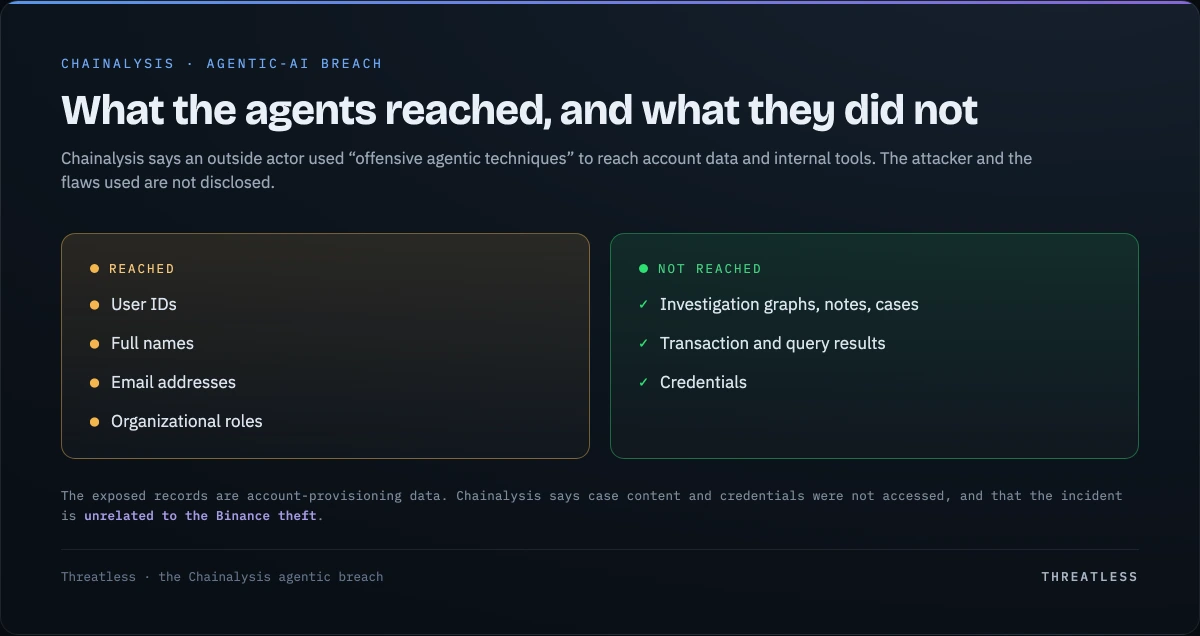
Chainalysis, the blockchain analytics firm, has disclosed that an outside actor used what it calls "offensive agentic techniques," meaning AI agents, to reach its systems and internal tools in October 2026. A company spokesperson confirmed the incident to BleepingComputer and said Chainalysis is working with external cybersecurity experts. The records the attacker reached were account-provisioning data for users set up on the platform: user IDs, full names, email addresses, and organizational role labels. Chainalysis says the incident is unrelated to the recent Binance theft. The phrasing is the part worth pausing on, because "offensive agentic techniques" is a named company telling the market that AI agents, not only a human with a toolkit, were part of how its environment was reached.
| Key fact | Detail |
|---|---|
| Target | Chainalysis, blockchain analytics firm |
| Method | "Offensive agentic techniques" (AI agents), per Chainalysis |
| Data reached | User IDs, full names, email addresses, organizational role labels |
| Not accessed | Investigation graphs, notes and cases; transaction and query results; credentials |
| Status | Company confirmed; attacker, exploited flaws and the agents' role undisclosed |
What happened
Chainalysis disclosed the breach in a notice reflected by BleepingComputer's report and by SecurityWeek around October 31, 2026, a day after an earlier account circulated based on a single third-party source. In the company's telling, the attacker reached account-provisioning data, the records that describe who is set up to use the platform. That means user IDs, full names, email addresses, and organizational role labels for provisioned users.
Chainalysis says a larger category of data was not reached, based on the evidence available to it so far. Investigation content, the graphs, notes, and cases that analysts build, was not accessed. Neither were transaction results nor query results, the outputs of the analytics work itself. Credentials were not reached either. Put plainly, the records that identify users were exposed, while the investigative material those users produce, and the passwords that protect it, were not, by the company's current reading. Even on its own, that provisioning data has value to an attacker, because a verified list of named people, their work emails, and their roles inside an organization is raw material for targeted phishing and social engineering. A breach that stops short of case files is not, for that reason, a breach without consequence.
What Chainalysis has not explained is as notable as what it has. It has not named the attacker. It has not described the vulnerabilities that were exploited. And it has not said which stages of the operation actually used agentic, meaning autonomous, AI capability, as opposed to conventional hands-on-keyboard work. It is also unclear whether the actor used an existing agentic offensive-security framework, one reported elsewhere under the name ARTEX, or custom-built AI agents assembled for this job. Chainalysis adds that the incident is unrelated to the Binance theft, which is a separate event.
Why it matters
For most of the past year, "AI in offensive security" meant a model that helped a human: drafting a phishing lure, explaining a flaw, sketching a script. The operator still ran the attack. A named company now saying its systems were reached through "offensive agentic techniques" points at something further along, where agents take actions rather than offer suggestions. The disclosure lands days after threat actors were reported running real intrusions with AI agents, the broader shift this case sits inside. For readers who want the ground floor, our pillar on agentic AI in cybersecurity walks through what "agentic" means and where it changes the threat model.
Two cautions keep this honest. First, the Chainalysis disclosure and the separately reported campaign in which CrowdStrike tied a China-linked group's use of an AI agent framework, reported under the name ARTEX, to more than 200 organizations are not confirmed to be connected. They are distinct events that happen to share a theme. Second, a disclosure this thin does not let anyone reconstruct the attack. What defenders can take from it is narrower, and still useful: assume that the slow, skilled stages of an intrusion, the parts that long kept capable operations rare, are precisely the parts these agents are built to automate, and plan for an adversary who can run those stages cheaply and often.
For a defender reading a case this sparse, the steadier posture is to act on the confirmed loss and hold the rest as an open question. The user-identifying data is the part to treat as real: notify the people whose names, emails, and roles were exposed, and watch for targeted phishing that leans on exactly those details. The agentic framing, by contrast, is the company's to substantiate, and the useful signal is the behavior it points to rather than the label put on it.
The skilled, patient hours an intrusion used to demand are exactly what an agent is built to compress, which changes how many attacks one adversary can run.
The honest reading of this case is not alarm. It is that the economics of offense are shifting, and that a security-adjacent company with real defenses was still reached. When the costly human stages of an attack can be handed to software, the number of competent operations an adversary can mount stops being bounded by how many skilled people they employ. That is the change worth planning around, even while the specifics of this particular breach stay undisclosed.
The exposure read
The durable lesson here is not the specific flaw, which Chainalysis has not shared. It is the tempo: as attackers put AI to work, the slow and costly stages of an intrusion get cheaper, and defenders cannot answer machine speed with quarterly effort. The practical takeaway is to treat exposure management as an AI-native, continuous discipline, so that when an agent reaches a provisioning system or an internal tool, the paths from that foothold to anything valuable are already understood and cut where they can be.