
News / Industry
Citrix patches NetScaler SAML zero-day CVE-2026-88779 under attack
Citrix patched CVE-2026-88779, a SAML authentication zero-day in NetScaler ADC and Gateway rated CVSS 8.7, under active exploitation. CISA added it to KEV.
The Citrix NetScaler flaw tracked as CVE-2026-88779 broke in early October 2026, and weeks later it is still worth your attention. It is a memory-buffer vulnerability in NetScaler ADC and NetScaler Gateway, rated 8.7 on CVSS, and Citrix shipped a fix on October 4 while attackers were already exploiting it in what the vendor calls targeted attacks on unmitigated deployments (BleepingComputer). Citrix classifies the impact as denial of service and says it has not identified an impact on the integrity of customer data. The reason this still matters in November is twofold: unpatched appliances are still being targeted, and researchers are still studying whether the same bug also allows remote code execution. One honeypot was found running a malware binary it had downloaded, a signal that the story may not be finished.
| Key fact | Detail |
|---|---|
| CVE | CVE-2026-88779 |
| Product | NetScaler ADC and NetScaler Gateway (appliances using SAML authentication) |
| CVSS | 8.7 (High) |
| Impact | Denial of service; possible remote code execution under investigation |
| Exploitation | Active since October 2, 2026; added to CISA KEV on October 4, 2026 |
| Fix | NetScaler ADC and Gateway 14.1-73.41 and 13.1-64.28 |
What happened
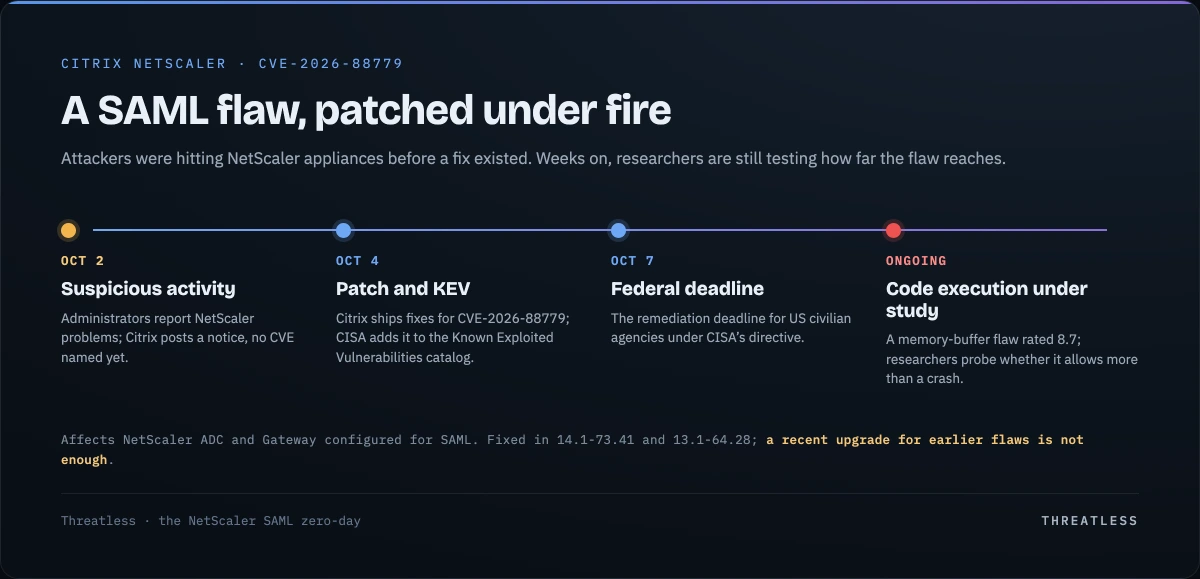
The sequence was fast. On October 2, 2026, Citrix published a security notice describing a newly observed issue on NetScaler, without naming a CVE, after suspicious activity surfaced in administrator reports. Two days later, on October 4, the company followed with a CVE-specific advisory and fixed builds for CVE-2026-88779. The same day, CISA added the flaw to its Known Exploited Vulnerabilities (KEV) catalog and set a remediation deadline of October 7 for US federal civilian agencies (BleepingComputer).
The vulnerability is not reachable on every NetScaler. It affects appliances configured to use SAML authentication through the Gateway or AAA functionality. In practice that means the box is set up as a SAML service provider, configured with add authentication samlAction, or as a SAML identity provider, configured with add authentication samlIdPProfile. Deployments without a SAML role in that authentication path are not in scope for this one.
What the flaw does is still being pinned down. Citrix describes a memory-buffer issue and classifies the impact as denial of service, stating it has not identified an impact on the integrity of customer data. Researchers are investigating whether the same bug can be pushed further, into remote code execution. The activity was reproduced by watchTowr Labs and examined by researcher Kevin Beaumont after NetScaler administrators flagged it on Reddit, and one honeypot was observed running a malware binary it had pulled down. That is a signal worth taking seriously, but it is not proof of code execution, and Citrix did not credit a single discoverer.
There is a caveat that catches teams off guard. Organizations that recently upgraded to address an earlier run of NetScaler flaws, CVE-2026-88771 through CVE-2026-88778, are not covered against this one, and they have to upgrade again. Citrix also offers Global Deny Lists as an interim measure for those who cannot patch immediately.
Why it matters
NetScaler sits in a category attackers have learned to prize: the enterprise edge appliance. ADC and Gateway terminate remote access and broker authentication for large organizations, they are exposed to the internet by design, and they hold a privileged position between untrusted traffic and internal systems. NetScaler in particular carries a history as a high-value target; the Citrix Bleed vulnerabilities of recent years turned the same product line into a mass-exploitation event. When a flaw lands in authentication code that an appliance answers before a user has logged in, the barrier to reaching it is low.
That pre-authentication exposure is the heart of why SAML matters here. SAML handles the single sign-on handshake, so the vulnerable code runs as part of accepting or issuing an authentication assertion, work the appliance does for anyone who can reach its login surface. An attacker does not need valid credentials to get the device to process a crafted request. For now the confirmed outcome is denial of service, knocking the appliance offline, but the open question of whether the same memory-buffer flaw can be driven to code execution is exactly what keeps this on watchlists weeks after the patch.
The pattern is not unique to Citrix. In the same stretch, researchers documented an Ivanti Connect Secure zero-day chain that reached root on fully patched VPNs and a Cisco ASA and FTD VPN zero-day exploited in the wild. Different vendors, the same profile: reachable from outside, privileged on the inside, and rarely able to run the endpoint tooling that would catch an intrusion elsewhere.
An appliance that authenticates the world before anyone logs in is only as safe as the code that reads the first request. On the edge, that code is the perimeter.
The attack-surface read
The first move after an advisory like this is not the patch, it is the question the patch assumes you can answer: which NetScaler appliances you run, which are reachable from the internet, and which have SAML configured as a service provider or identity provider. This is the premise Threatless is built on, AI-native exposure management that keeps the picture of what you expose to the internet current, so an advisory turns into a short list of hosts to fix rather than a guessing game. Confirm your NetScaler builds against Citrix's fixed versions, prioritize the SAML-configured appliances an attacker can reach from the internet, and if you want the groundwork, read what a zero-day actually is.