
News / Industry
The $6.3 billion Binance theft and what it says about exposure
Binance reported a roughly $6.3 billion theft, described as the largest crypto theft on record. The security lesson is attack path and exposure, not crypto.
On or around October 29, 2026, the cryptocurrency exchange Binance reported a theft of roughly $6.3 billion. If the figure holds, it ranks as the largest cryptocurrency theft on record, and by several accounts the largest theft of any kind in history. The number is staggering. The detail that should hold a security team's attention is smaller and more ordinary: Binance reportedly traced the intrusion to several breach points, one of them a compromised laptop.
That is not really a crypto story. It is an attack path story, and it is the same story behind most large breaches.
| Field | Detail |
|---|---|
| What | A reported theft from the Binance exchange |
| When | On or around October 29, 2026 |
| Amount | Roughly $6.3 billion (provisional, per reporting) |
| Entry point | Several breach points, including a compromised laptop (per Binance) |
| Status | Under investigation; figures and attribution still emerging |
What happened
Forbes reported that the loss approached $6.3 billion and described it as the largest cryptocurrency theft on record. By multiple accounts, October 2026 became the costliest month in the history of cryptocurrency hacking. Binance said it traced the attack to several breach points, including a compromised laptop, rather than to a single catastrophic flaw in its core systems.
Those figures are provisional, and they deserve to be read that way. Loss estimates in the first days after a crypto incident come largely from the exchange's own disclosures and from third party trackers that follow funds across the chain, and they tend to move as freezing, recovery and reconciliation play out. Attribution is less settled still. No primary source has confirmed a specific actor, so the responsible position is to report what Binance and reputable outlets have said and to resist filling the gap with a named group.
Why it matters
A loss of this size is a market event, and it will drive its own conversations about custody, reserves and regulation. For defenders outside the crypto world, the instructive part is not the asset that was stolen. It is how the attackers got from the outside to it.
Exchanges are concentrated targets: they hold liquid, portable value, which raises the payoff for an attacker and the budget they will spend to win. But the shape of this intrusion is not exotic. A single endpoint was compromised, and that foothold became a route to systems holding enormous value. Swap the asset for patient records, source code or payment data, and the same sequence describes breaches in almost every industry.
From one laptop to the crown jewels
The mechanism that matters is the chain, not the sum. A laptop is a reachable, unremarkable thing. It is exactly the kind of asset that rarely tops a risk register, because on its own it looks low value. The crown jewels, the systems holding the money, sit behind layers of control and are watched closely. Attackers know this, so they seldom start at the vault. They start at something exposed and ordinary, then move.
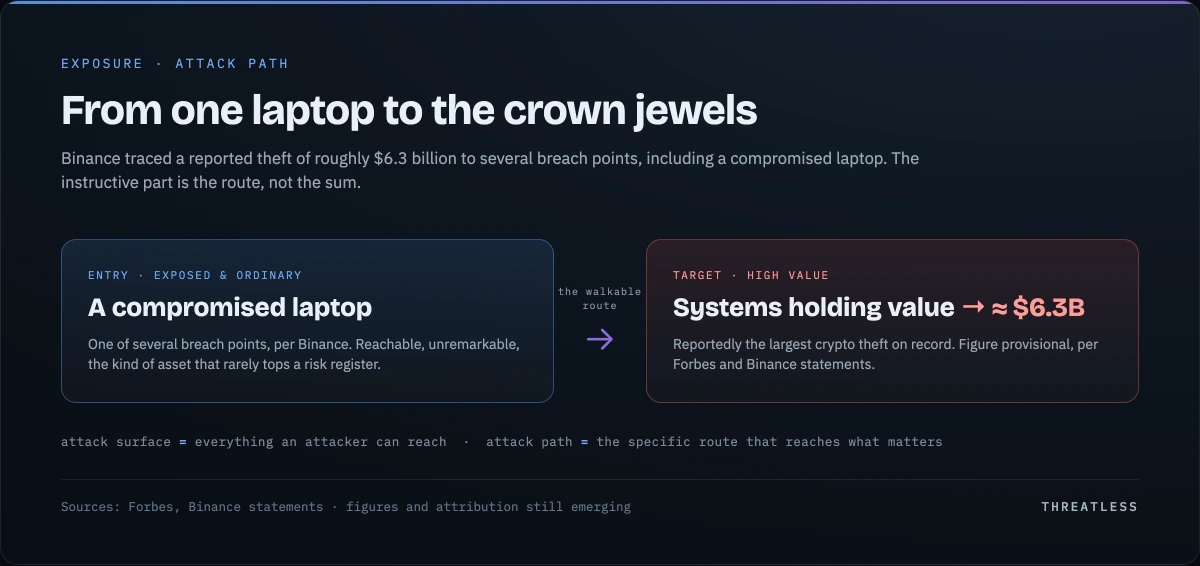
This is the difference between an attack surface and an attack path. The surface is all the laptops, accounts, services and credentials an attacker could reach. A path is the specific, walkable route that connects one of those exposures to something that matters. A list of thousands of findings tells you the surface is large. It does not tell you which handful of them link together into a line that ends at the money.
The largest losses rarely begin at the crown jewels. They begin at a reachable, unremarkable exposure and chain inward.
That reframing is the point of exposure management. The useful question after an incident like this is not how many vulnerabilities an organization has. It is which exposures sit on a path to something valuable, and which of those paths can be cut. A compromised laptop is survivable when it leads nowhere. It becomes a headline when the route from it to the assets is open and unwatched.
None of this is unique to Binance, and none of it depends on the final number landing at exactly $6.3 billion. Whether the figure settles higher or lower, the lesson holds. Map the surface, then prioritize the paths that reach what matters, and close them before they are chained inward. The biggest story of the month started, by Binance's own account, at one of the smallest and most forgettable points on the map.