
News / Industry
Android 'SMS of Death' flaw crashes phones with no tap, patched Oct 2026
Android's October 2026 bulletin patches critical zero-click DoS flaws in MMS PduParser, the 'SMS of Death.' A crafted message crashes phones with no tap.
Android phones can be crashed by a single crafted message, with no tap, no link to click, and no notification at all. Two flaws in the way Android parses binary messaging data, the kind that carries MMS and WAP Push, let a remote attacker trigger a denial of service against a phone's messaging and telephony process. Google fixed both in the October 2026 Android Security Bulletin and rated each one critical. Researchers have nicknamed the technique the "SMS of Death," though the real channel is message parsing, not a plain text SMS.
| Key fact | Detail |
|---|---|
| CVEs | CVE-2026-55265, CVE-2026-58865; security press also cites CVE-2026-58882 for the public proof of concept |
| Component | Android binary message parsing (PduParser.java); the public PoC targets the related WAP Push over SMS path |
| Impact | Remote denial of service, no user interaction, no privileges: crashes the messaging and telephony process |
| Affected | Android 14, 15, 16, 16-qpr2, and 17, per the bulletin; older Android 12 and 13 reported to remain exposed |
| PoC status | Public proof of concept published by the researcher, per BleepingComputer |
| Fix | October 2026 Android Security Bulletin, security patch level 2026-10-01 |
| Mitigation | Install the October 2026 update, then delete the offending message to clear a crash loop |
What happened
Two critical DoS flaws in Android's PduParser
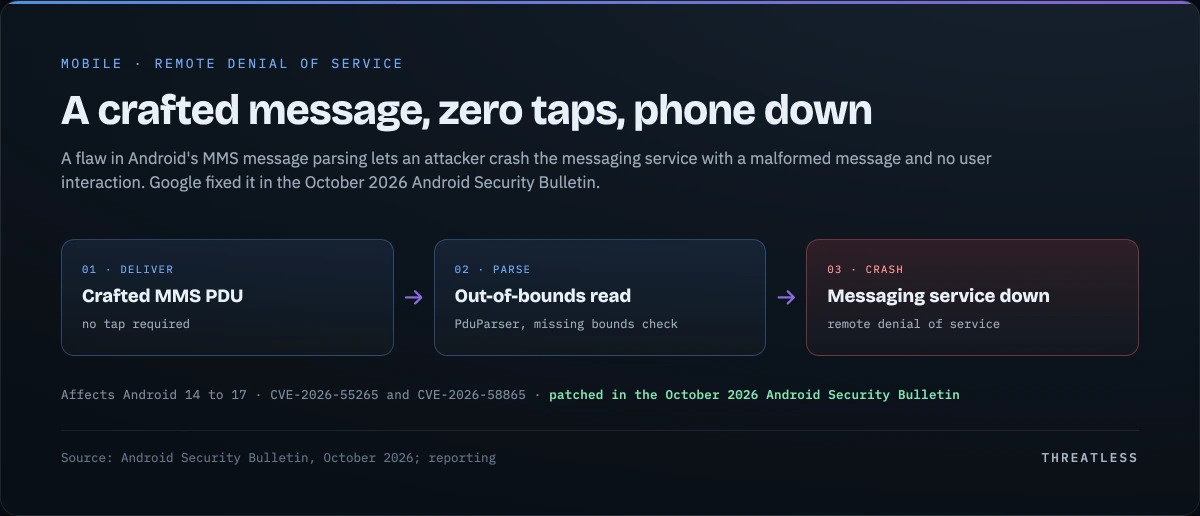
The October bulletin lists two critical denial of service issues in Android's handling of message PDUs, the protocol data units that encode multimedia and WAP Push messages. The National Vulnerability Database describes CVE-2026-55265 as an out of bounds read "in multiple functions of PduParser.java," caused by a missing bounds check and reachable remotely with no added privileges and no user interaction. CVE-2026-58865 is a related, persistent denial of service in the same parser, also traced to a missing bounds check. Google rated both critical and shipped the fix at the 2026-10-01 patch level for Android 14 through 17; the bulletin describes the most severe of the set as a bug that "could lead to remote denial of service" with no added privileges and no user interaction.
The "SMS of Death" public proof of concept
What pushed the story into the open was a public proof of concept. On October 31, BleepingComputer reported a zero-click crash that independent researcher Mark Blaszczyk nicknamed the "SMS of Death," tracked in that coverage as CVE-2026-58882. The payload arrives as a data SMS aimed at a messaging port rather than a readable text, so it never reaches the inbox and raises no notification. A malformed header length is converted into a negative value, Android then tries to allocate an array of that size, and the resulting exception terminates the com.android.phone process. Each crash interrupts service for a second or two while the process restarts, and CyberInsider reports it can disconnect active calls, including emergency calls.
Sent in volume, the effect compounds. The researcher found that rapidly delivering roughly 20 to 30 messages can corrupt the SQLite database Android uses to store SMS, turning a momentary crash into one that repeats at every boot, per BleepingComputer. One older handset reportedly rebooted into recovery about every 90 seconds until it was factory reset. The naming is still unsettled: the two bulletin fixes carry PduParser identifiers, the public exploit is reported under CVE-2026-58882, and at least one outlet noted that no CVE had been assigned at disclosure. What the accounts agree on is the shape of the bug, a bounds check missing from code that parses attacker-controlled binary messages, and its outcome, a crash rather than code execution.
Why it matters
Zero-click bugs remove the one defense most security advice leans on: the user. There is nothing to avoid clicking. Android's messaging stack has carried this kind of risk since the Stagefright flaws of 2015, because it parses complex, attacker-controlled formats before a person ever sees them. Denial of service is not the worst outcome a parser bug can produce, but a phone that drops calls, including emergency calls, or loops on reboot is a safety problem, not a nuisance.
The harder problem is delivery. Google can rate a flaw critical and publish a fix on the first of the month, yet that patch still has to pass through device makers and carriers before it reaches a handset, and many phones in the field never receive it. The reported split here, with Android 14 through 17 patched while 12 and 13 are left waiting, is the patch-gap reality of large Android fleets in miniature. The defender's lesson matches the one for servers: a fix counts only once it is deployed, and knowing which devices are actually exposed is half the work. That is the case for prioritizing by real risk instead of raw severity, for separating a reachable attack surface from an exploitable attack path, and for reading CVSS, EPSS, and KEV together rather than trusting any one score. This case shows why: the Android bulletin rates CVE-2026-55265 critical, while the NVD entry lists a CVSS base score of 6.5. One flaw, two readings. It also lands in a heavy month, alongside Microsoft's record October Patch Tuesday and a run of major incidents that made the same case for triage over volume.
A patch dated the first of the month protects no one until it reaches the phone in someone's pocket.
The Threatless read
The "SMS of Death" is a denial of service, not remote code execution. No source we reviewed reports code running on the device or data leaving it, and that line matters: the honest version of this story is narrower and still serious. A crafted binary message can knock out calls and messaging on an unpatched Android phone with no interaction, and in volume it can keep the device unusable until the message is cleared or the phone is reset.
For individuals, the step is simple. Take the October 2026 update as soon as the device offers it, and if a phone starts crashing or dropping calls for no clear reason, treat a recent message as the first suspect.
For organizations, the exposure is the fleet, not the single phone. The questions worth answering are which devices are enrolled, which are stuck on Android 12 or 13, and how quickly a critical mobile patch actually propagates. That continuous view of exposure, knowing what you run, where it is reachable, and which fix to ship first, is what platforms such as Threatless CTEM and Threatless Surface exist to provide. Mobile is part of the attack surface, not an exception to it, and a one-line message should not be the thing that decides your week.